
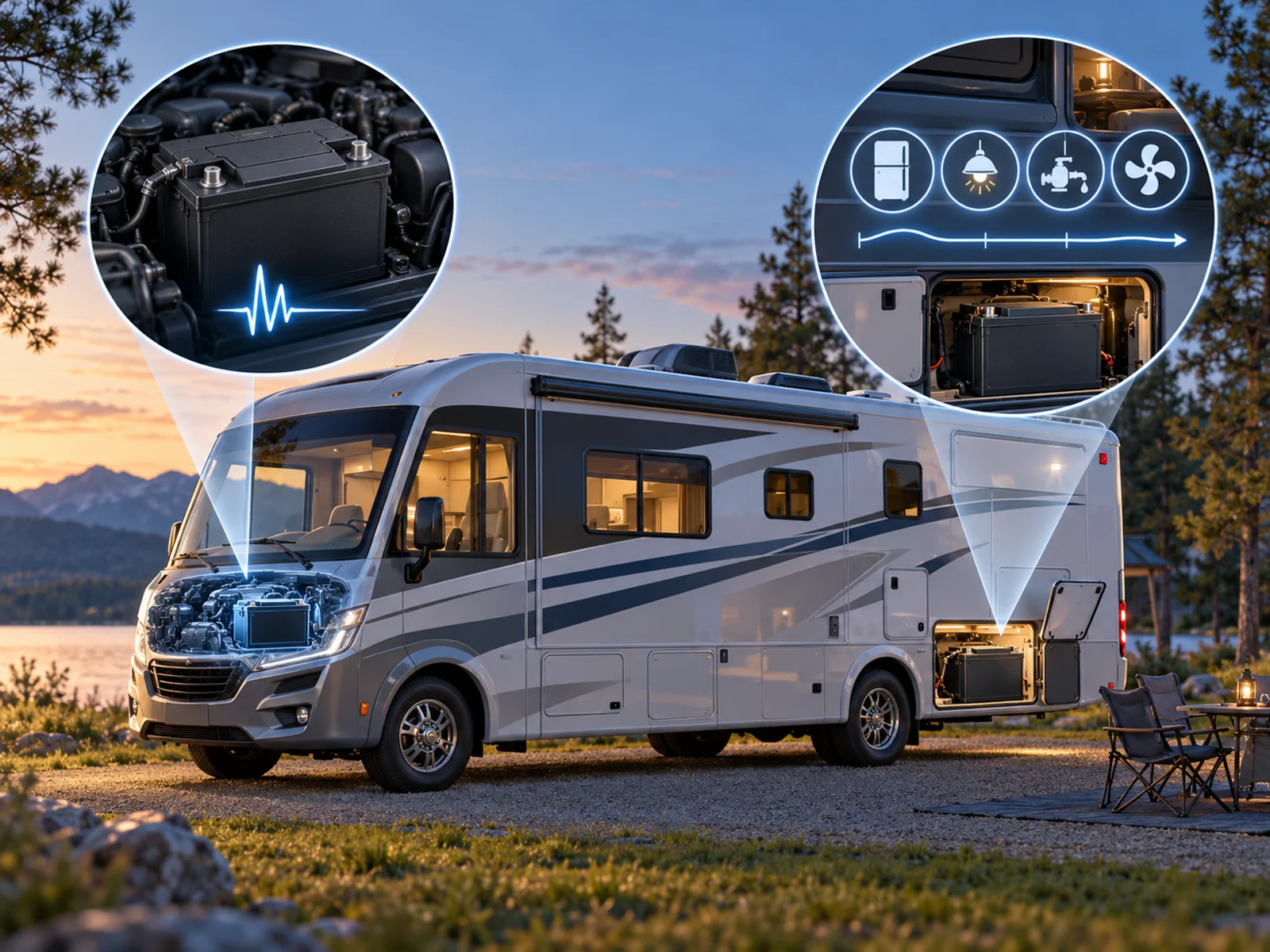
An RV starting battery may deliver high current for only a short period. After the engine stops, the refrigerator, lighting, water pump, fan and electronics may keep drawing power for hours. Both use batteries, but their load patterns differ. The AGM label alone does not establish suitability for house power.
Construction and duty
AGM is a construction, not a duty rating
AGM stands for Absorbent Glass Mat. A glass-fiber separator holds electrolyte in a construction commonly used in valve-regulated lead-acid batteries. Starting, deep-cycle and dual-purpose describe the work the battery was designed to perform. Trojan distinguishes brief high-current starting demand, extended equipment supply and a compromise between starting and light cycling. This is a useful selection framework, but the specifications, maintenance instructions and limitations of the individual model remain decisive; one manufacturer's limits should not be applied to every AGM battery.
Load profile
Starting an engine does not prove suitability for house loads
List devices that may operate together, their power and expected runtime. Include inverter losses and the momentary starting demand of compressors and pumps. A starting battery may temporarily power lights, but repeated deep discharge must be within that model's intended operating range; Trojan states that its starting batteries are not designed for repeated deep discharge. Frequent short trips with daily charging differ from extended parking supported by solar or shore power. Temperature, installation location, ventilation, maintenance and the available recharging window also matter. Compare this load profile with the model's discharge capability and the vehicle-system design.
Capacity conditions
Read amp-hours with test conditions and usable capacity
Battery capacity changes with discharge current. Similar amp-hour ratings measured at different rates cannot be assumed to provide the same result. Confirm the current or discharge duration, end voltage and test temperature before comparing. Rated capacity is separate from usable capacity at the allowed depth of discharge, and actual loads and inverter efficiency affect runtime. Use manufacturer data close to the intended duty, with allowance for cold conditions, ageing and delayed recharging. One Ah figure cannot predict an entire night or journey, and a generic runtime estimate is not a model-specific guarantee.
Charging and layout
Check charging compatibility and the one-bank or two-bank design
The alternator charger, solar controller and shore-power charger need voltage settings and charging stages compatible with the selected model. Persistent undercharging or overcharging affects operation and service-life management, so review existing equipment when replacing a battery. With separate starting and house banks, select each against its own duty and check charging and isolation against the vehicle design and equipment instructions. For a manufacturer-designated dual-purpose bank, calculate starting capability and house runtime separately, checking cycling data, recommended discharge limits and warranty terms. Neither layout suits every RV. Qualified modification or service personnel should evaluate wiring, protection or charging changes; a general article is not a rewiring guide.
Separator boundary
The separator cannot define the duty of the complete battery
An AGM separator keeps positive and negative plates apart, retains electrolyte and contributes to ion-transport conditions within the plate group. Plates, active material, acid quantity, compression and overall cell design also influence battery performance. H&V's overview supports the material-function explanation; it does not establish Viking specifications or the RV suitability of a finished battery. Users should first select by intended duty and system conditions, then compare AGM, flooded and other constructions. Battery manufacturers must validate the separator with the target plate structure, compression design and electrolyte-management approach. Similar AGM labels can still accompany different design priorities and performance data.
Procurement questions
What should a battery manufacturer share for separator matching?
Can any AGM serve as an RV house battery? Confirm the individual model's intended duty and performance data. Can a dual-purpose model serve both roles? Only if its starting, runtime and charging data meet the actual system requirements. Viking supplies AGM separators and supports specification discussions with battery manufacturers; a material request alone cannot select or guarantee the vehicle's complete electrical system. Share the expected loads, cycling pattern, plate-group structure, separator thickness, roll or sheet dimensions and test conditions to prepare samples and a complete-battery validation plan.