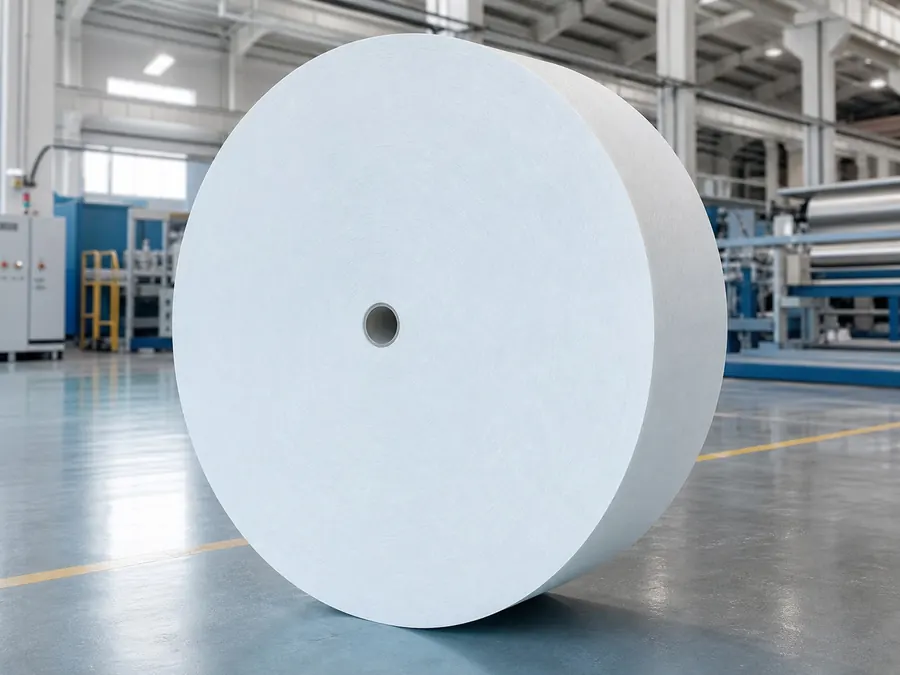

An AGM separator has no terminal and does not generate voltage, yet it is sometimes called the ‘third pole’ of a valve-regulated battery. The expression highlights its importance, but it is not a formal electrochemical classification.
A more accurate description is a critical working interface: it separates the plates, retains electrolyte, supports ion-transport and oxygen-transport conditions, and contributes to plate-group contact. None of these functions independently determines battery life or power.
Function boundary
Four functions that still need complete-battery verification
Separate plates
- Related material condition
- Thickness, dimensions and strength
- Verification boundary
- Material dimensions do not validate the complete battery structure.
Retain electrolyte
- Related material condition
- Porosity, basis weight and absorption-related behavior
- Verification boundary
- More absorption does not replace design matching.
Support oxygen transport
- Related material condition
- Pore, liquid-retention and compression state
- Verification boundary
- The separator is not the sole agent of oxygen recombination.
Maintain contact
- Related material condition
- Thickness, compression and recovery
- Verification boundary
- Evaluate with plates, pressure and complete-battery testing.
Meaning
A useful metaphor, not a third electrode
CN105006540B uses ‘third pole’ in its background discussion of AGM separators, while its claims concern a separator production system and method. For purchasing and engineering teams, the phrase is best used as a reminder to evaluate the separator in the complete battery—not as a new electrode category.
Electrical separation
It blocks direct electronic contact while ions move through wetted pores
The separator keeps positive and negative plates from directly touching and reduces internal-short risk. It should not provide a direct electronic path; ions involved in battery reactions move through electrolyte-wetted pores. Resistance therefore needs defined electrolyte, plate and test conditions before it can be interpreted.
Electrolyte
Glass microfibers retain and distribute electrolyte
In VRLA batteries, the glass-fiber pore structure holds and distributes electrolyte between plates. Higher acid absorption is not automatically better: pore condition, plate absorption demand, acid volume and assembly conditions must be matched to the actual battery design.
Oxygen pathway
The separator supports oxygen transport but does not complete recombination alone
Partially saturated, connected pores can provide a path for oxygen generated at the positive plate to reach the negative plate, where it participates in water-forming reactions. State of charge, saturation, plate design, compression and temperature also influence this mechanism; separator data alone cannot prove oxygen-recombination performance.
Compression
Contact and compression are part of the design relationship
Thickness, compressed state and recovery interact with plate dimensions, group construction and assembly pressure. Material results are useful for screening and troubleshooting, but they do not predict complete-battery life from one thickness, absorption or compression value.
Project review
Validate the separator in the finished battery
Confirm dimensions, material data, acid filling and assembly conditions first; then validate with the agreed complete-battery test plan. Field behavior adds charging strategy, temperature and operating-use effects that a material test cannot reproduce by itself.
Plate separation
Thickness, dimensions and mechanical condition must support assembly without proving a complete battery structure.
Electrolyte retention
Porosity, basis weight and absorption-related behavior require matching with acid volume and plates.
Oxygen-transport conditions
Pore and liquid-retention state are only one part of gas-management behavior.
Contact and compression
Thickness, compression and recovery must be reviewed with the plate group and assembly method.