
From Planté formation cycles to Faure pasted plates, electrode manufacturing required more than rechargeability. Modern glass-fiber structures also need clear functional boundaries and validation.
Planté demonstrated storage, but formation was slow
Planté demonstrated storage, but formation was slow
The Science Museum Group holds a Planté battery from about 1860 with 20 cells switchable between series and parallel for experimental and laboratory use. Early Planté plates needed repeated charging and discharging to develop active surface material. Rechargeability had been demonstrated; producing practical electrodes efficiently remained a manufacturing challenge.
Faure put convertible material on the plate first
Faure put convertible material on the plate first
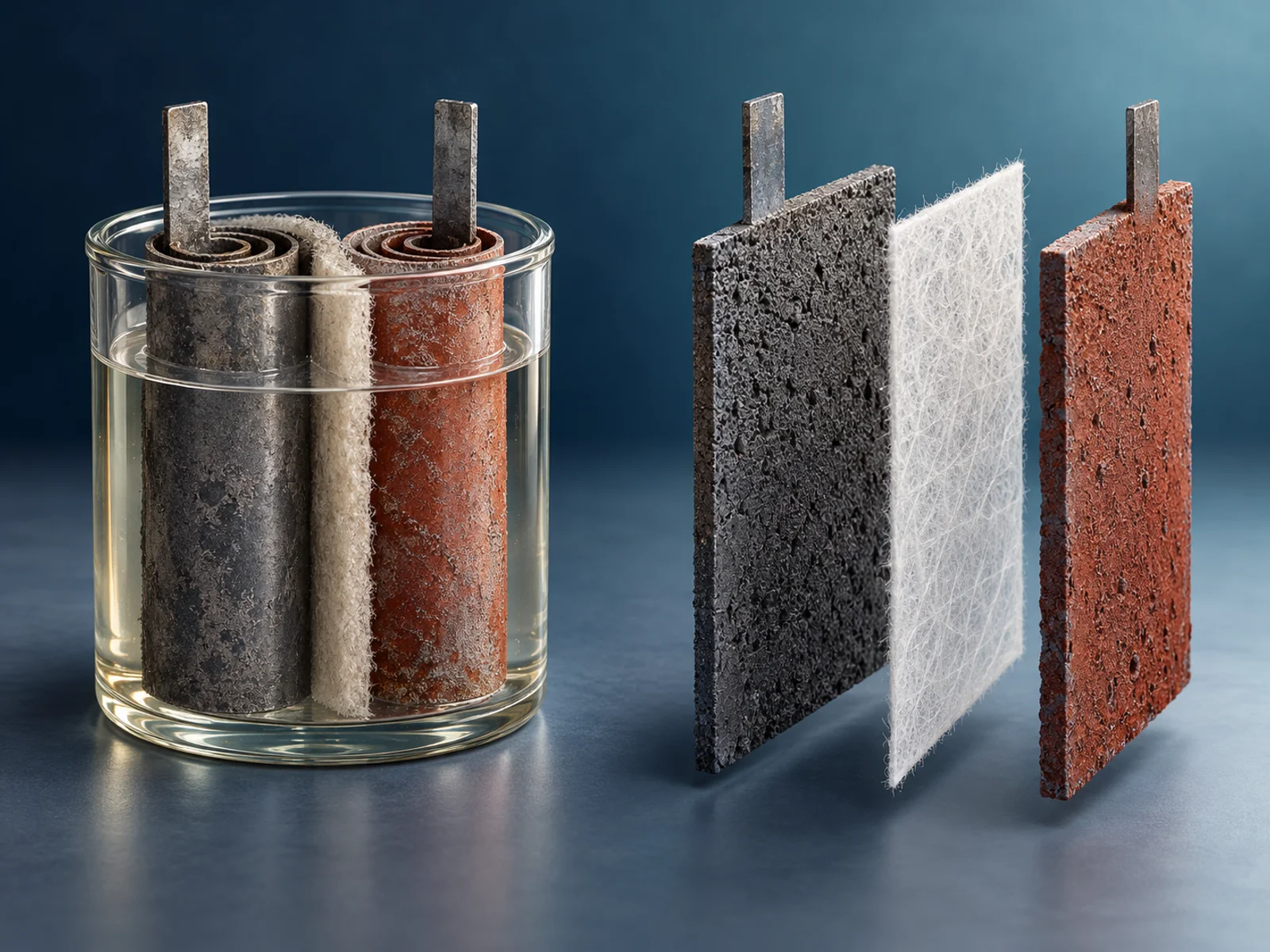
Nature reported on 19 May 1881 that Camille Faure coated lead sheets with red lead, Pb₃O₄, before electrical conversion. Two coated sheets were rolled with felt between them in dilute acid. Charging converted the coatings toward metallic lead at one electrode and lead dioxide at the other. This changed the formation route; electrical treatment was still required. The historical account is not a modern production specification.
A promising structure still needed measurements
A promising structure still needed measurements
In Nature on 16 June 1881, William Thomson said his measurements of charge and discharge energy losses were not yet complete and discussed the influence of operating rates. A new construction can offer a useful manufacturing route, but performance still needs measurements under defined conditions. His account does not establish modern efficiency or test limits.
GEM places glass fiber inside the negative electrode
GEM places glass fiber inside the negative electrode
ArcActive states that it jointly developed Glass Electrode Material (GEM) with H&V in 2024. Developer descriptions place a three-dimensional glass-fiber framework throughout the negative active material, replacing the conventional lead grid and supporting that material. Structural and performance statements belong to the developers and require review against the conditions of specific tests.
An electrode framework is different from an AGM separator
An electrode framework is different from an AGM separator
GEM is described as part of the negative electrode. An AGM separator sits between positive and negative plates, separating electrodes, retaining electrolyte and providing an ion-conduction path. The felt between Faure’s early rolled plates should not be called modern AGM. Faure and GEM illustrate related questions about material placement and support; the sources do not establish direct technical inheritance.
Define the structure before choosing validation
Define the structure before choosing validation
For an AGM discussion, identify battery design, separator position, target thickness, dimensions, sample state and compression or electrolyte conditions. Separate material measurements from complete-battery validation. Viking did not participate in GEM development or supply and has not independently verified its stated performance. No developer claim is presented as a Viking specification or guarantee.