
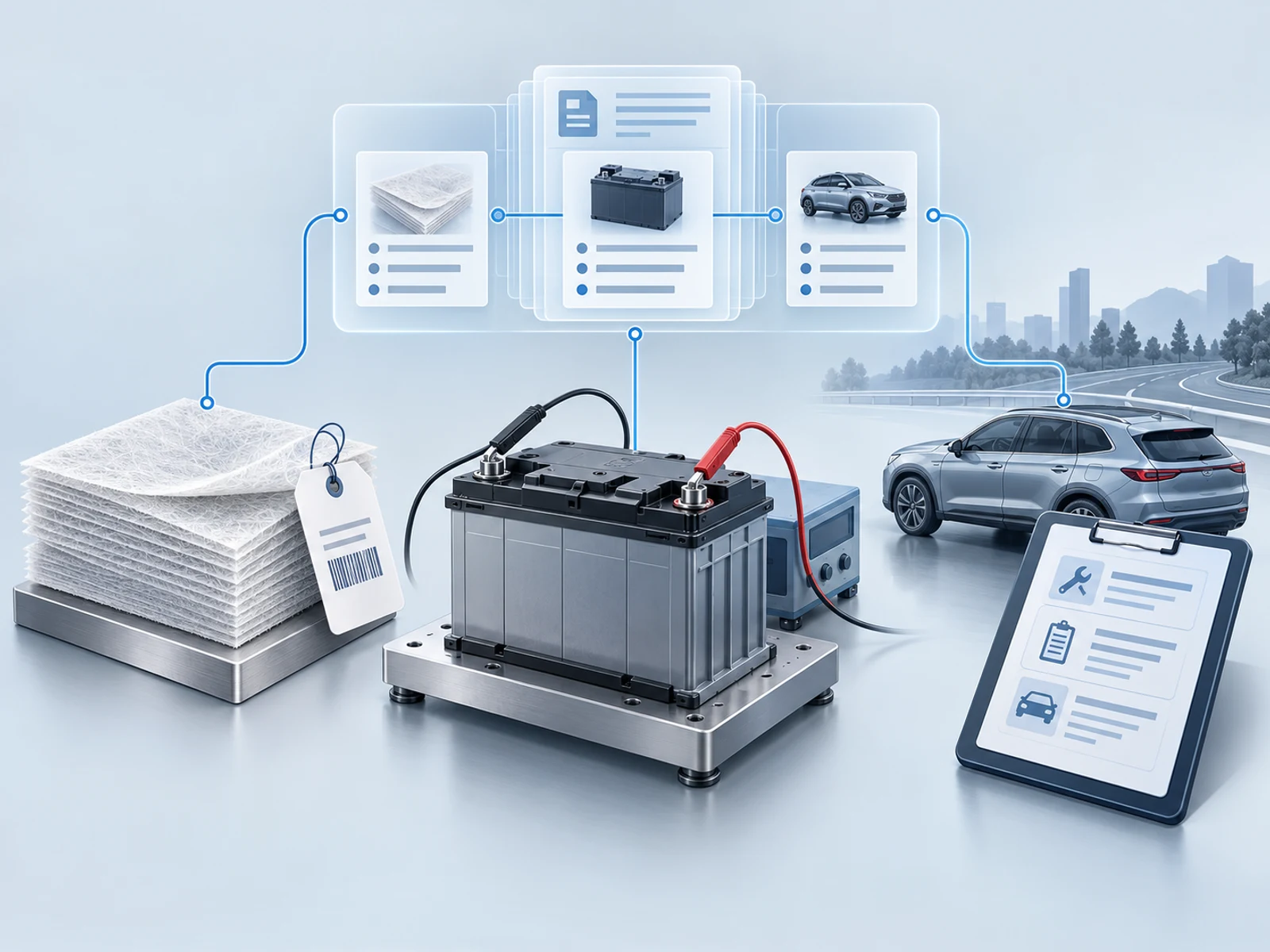
For battery manufacturers and application teams, the useful shift is from collecting isolated curves to explaining why comparable batteries age differently. Start with a common design, duty cycle and traceable records.
Fleet-service example
Early warning needs explainable data
Clarios’s September 14, 2026 page describes expanding Battery Manager engagement with European fleets. Connected hardware, cellular communication and cloud analytics provide battery health, state of charge and charging-system information for maintenance decisions. Clarios says results depend on vehicle, duty, environment and maintenance. The page does not disclose an algorithm, sample size or prediction accuracy. This is a Clarios service, not a Viking platform or a promise of an exact failure date.
Material evidence
Trace the starting material conditions
For an AGM battery health assessment—state of health, or SOH—retain separator batch identity, thickness, acid absorption, compression conditions and aging-related changes. These records help engineers check whether batteries of the same design began from comparable material conditions. Record the test method, sample state and measurement conditions alongside each result; an isolated material parameter cannot calculate SOH.
Battery evidence
Link aging results to battery design and test conditions
Whole-battery records should link capacity, internal resistance, charge-discharge behavior and post-cycle changes to battery identity, structure, temperature and the agreed test method. Keep aging stages and dates aligned with the relevant separator batch. Battery tests describe behavior under defined conditions; they are a separate evidence level from separator measurements.
Field evidence
Place field events on the same timeline
Field records should include vehicle type, duty cycle, temperature, charging-system behavior, anomalies and maintenance history. They help determine whether laboratory observations can reasonably explain service performance. A model can operate with incomplete evidence, but interpretation becomes harder. A field anomaly must not automatically be blamed on a separator, and material variation alone cannot predict vehicle failure.
Industry assessment
Consistency may help reduce unexplained variation
Viking’s industry assessment is that consistent starting materials may make comparable battery aging data easier to interpret. This is a rationale for controlling variation, not a demonstrated improvement in a particular model. Unexplained thickness, absorption or compression differences can obscure design, process and operating effects. Retain batch and aging records to support investigation; they do not form a finished predictive-maintenance solution.
Practical records
Build a shared evidence chain before a complex platform
Begin with repeatable fields for batch, key test conditions, battery aging results, field anomalies and maintenance timing. Map them to the same battery structure and target duty cycle, with clear record ownership. Viking does not provide independent battery-health monitoring or SOH calculation. For start-stop and low-voltage AGM batteries, discuss available material and aging records with battery and application teams; material tests cannot replace battery or field validation.
Material
Batch identity, thickness, absorption and compression conditions.
Whole battery
Capacity, resistance, cycling results and defined test conditions.
Field operation
Vehicle duty, environment, charging and maintenance history.
Traceability
Battery structure, dates and links across the three levels.