
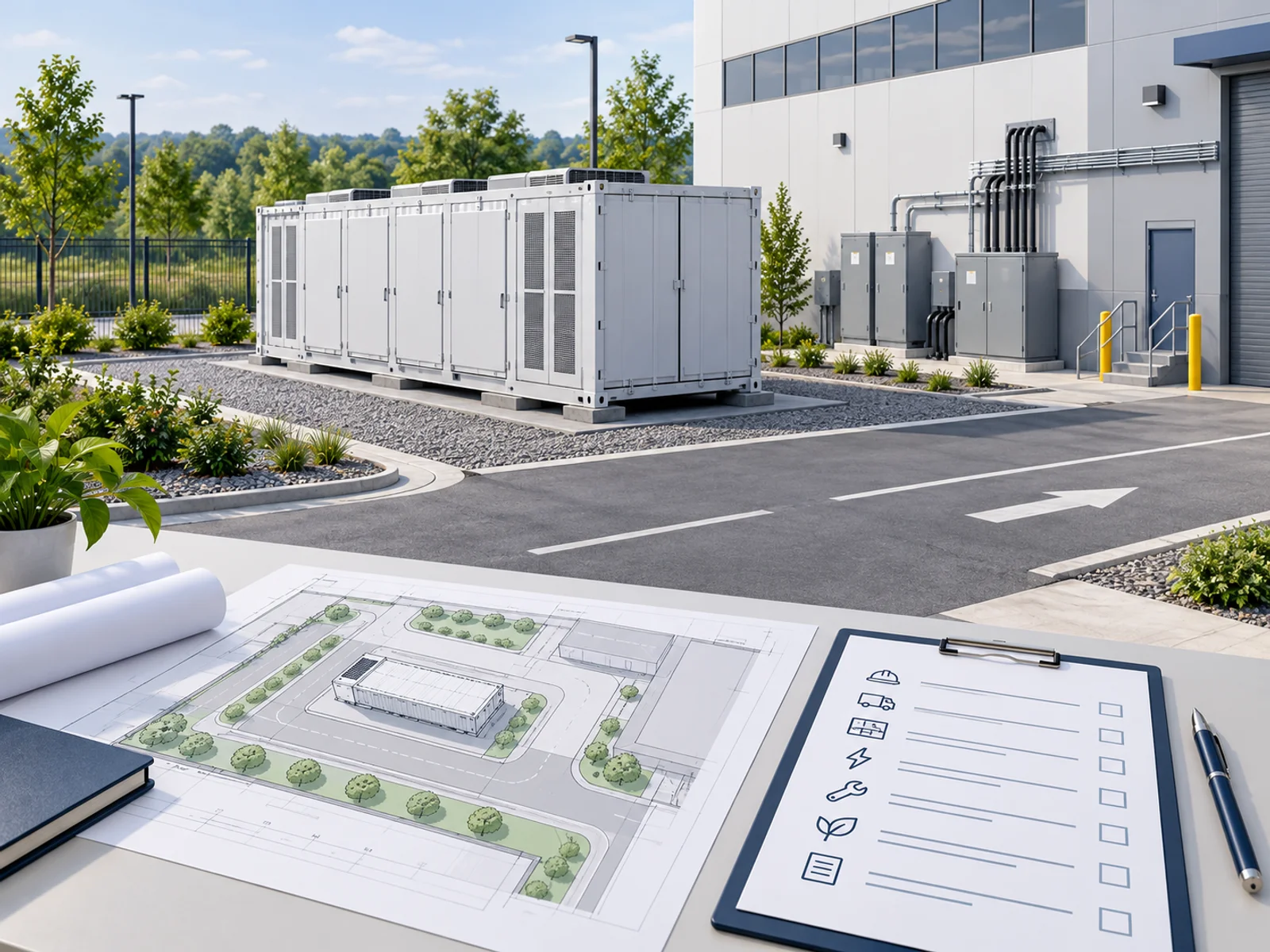
A battery equipment quote is not the complete budget for a commercial and industrial energy storage project. Site conditions and deployment requirements need assessment before solutions can be compared.
Budget scope
Equipment arrival is not the end of the project budget
From equipment arrival to operation, a project may involve site preparation, electrical connection, on-site engineering and installation, fire protection, other safeguards, emergency access, approvals and insurance. Requirements vary by project, and not every site incurs the same costs. These items cannot be inferred from the price of a particular battery.
Company disclosure
ArcActive describes its own deployment approach
ArcActive presents a containerized storage system for commercial and industrial applications. The company says spacing, fire protection, emergency access and other safeguards occupy space, add engineering complexity and may extend design, approval and installation timelines. It also says defined configurations and reuse of earlier engineering, planning and assessment work may reduce costs and deployment time. These are statements about its own solution, not independently audited conclusions for every project.
Pilot evidence
Operation is not proof of universal economics
According to ArcActive, its first pilot-scale containerized system is operating at Deakin University's Waurn Ponds microgrid in Australia in collaboration with Origin Zero. This confirms that the company has disclosed an operating field pilot. The cited page does not provide a complete, independently verifiable cost comparison or an independent audit. The pilot cannot establish that a solution will necessarily cost less at other sites.
Comparable requirements
Align the task before comparing solutions
Compare usable energy, load characteristics, site boundaries, cycling profile, temperature and operating requirements. Then review engineering, protection, connection and deployment conditions outside the battery equipment. Record what the quote includes and what still needs confirmation. This is a project-assessment approach, not a universal regulation, and does not replace compliance decisions for a specific project.
AGM boundary
Separator evaluation belongs at the battery-material level
Viking provides AGM separators with specification communication and matching support. An internal battery material cannot by itself determine engineering cost or the overall economics of a storage system. Evaluate AGM material when the target battery uses AGM construction; the ArcActive disclosure does not establish use of AGM or Viking materials in its system. Share cycling profile, operating temperature, plate-group structure and dimensions for application-fit discussions. System economics still require complete design and actual site evaluation.