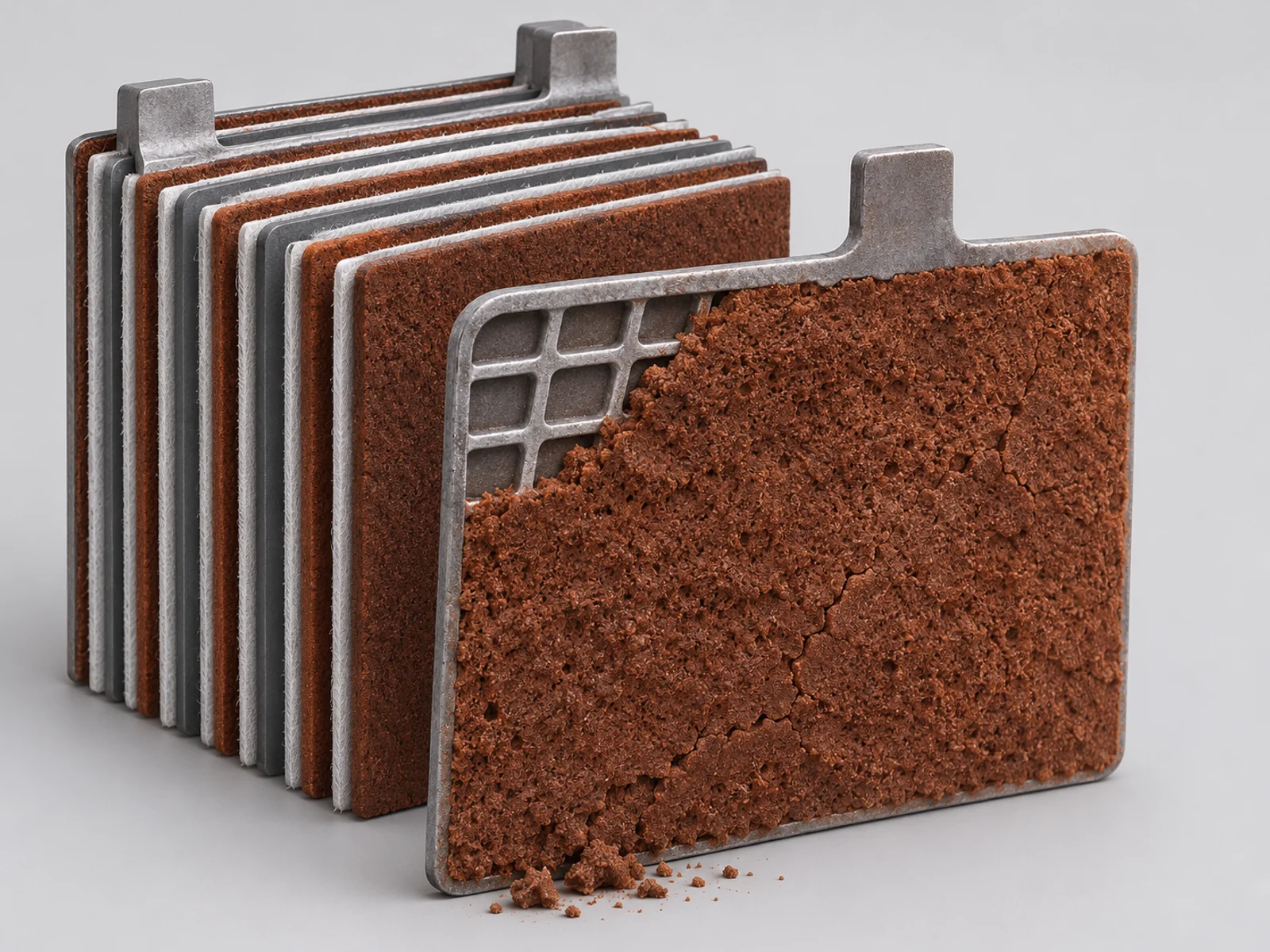
Capacity loss and visible shedding can appear at different stages of ageing. For cycling lead–acid batteries, quality and R&D teams should connect structural observations with operating records and controlled complete-battery validation.
Softening can begin with weaker particle contact
Softening can begin with weaker particle contact
Positive active material consists mainly of lead dioxide. Charge and discharge change its structure, and repeated cycling can weaken connections between particles. A 2001 study describes softening through loss of contact as the active mass expands, with capacity consequences particularly relevant to higher-rate discharge. Reduced electrical connectivity may therefore precede conspicuous detachment. This is an interpretation of the mechanism, requiring evidence beyond a photograph. Capacity trends, resistance changes, appearance and teardown findings each describe a different aspect of battery condition. Record them together with the design and test history before drawing a causal conclusion.
Cycling degradation has interacting influences
Cycling degradation has interacting influences
Plate formulation and structure, the grid-to-active-material interface, electrolyte condition, charging, discharge rate, depth of cycle and temperature can all influence the investigation. Element-group construction can change how the same material set behaves. A shedding observation from one project cannot be transferred directly to every battery design. Identify when the capacity or cell behaviour changed, where abnormalities appeared and whether a comparable control group was tested. These records help narrow the investigation. Controlled validation is needed to determine which variable accounts for the observed change.
Evaluate compression within the battery design
Evaluate compression within the battery design
A theoretical paper published in 2000 examined positive-electrode compression and active-material stability. The separate 2001 experimental study compared AGM, gel and AJS separation systems under different initial compression conditions. Their conclusions concern the models, materials, constructions and tests examined. The systems had different compression characteristics, which must accompany any comparison. Evaluate plate-group space, separator compression and recovery, active-material condition and operating duty together. The papers provide research context for a validation plan. They do not establish a pressure setting for every design or a performance commitment for Viking separators.
The AGM separator participates in restraint
The AGM separator participates in restraint
A 2002 paper identifies electrolyte supply, oxygen transport and restraint of active-material growth as important separator functions in VRLA batteries. AGM therefore participates in the structural conditions within the plate group alongside its insulating role. Plate formulation, compression design, electrolyte conditions and cycling duty still affect finished-battery results. An isolated separator property cannot demonstrate that a particular battery will avoid shedding or achieve a stated life. Likewise, shedding alone cannot establish the separator as the cause. Viking’s related article on pressure retention after filling and cycling provides material-test context for this discussion.
Keep observations and causal tests traceable
Keep observations and causal tests traceable
Define the test object, comparison conditions, target variable and endpoints before interpreting a plate change. Keep plates, materials, charge and discharge regimes, temperature and battery construction comparable between control and test groups. When compression is the variable, document it explicitly and avoid changing several components simultaneously. Trace capacity trends, cell-level readings and teardown observations to individual samples and cycles. A photograph records material condition at inspection. Material tests support comparisons of separator samples. Complete-battery tests are needed to assess how those observations relate to the target design and service duty.
Prepare a separator sample discussion
Prepare a separator sample discussion
Viking supplies AGM separator rolls and sheets and supports specification discussions with battery manufacturers. Provide the application, cycling conditions and required sample form to begin an R&D or quality review. Include the plate-group space, relevant compression or recovery test definition, and the proposed validation conditions when available. Initial discussions can use non-confidential operating requirements. The customer determines material suitability using its battery design and corresponding validation results. Submit your application and cycling conditions to request an AGM separator sample.
FAQ 1
Can particle contact weaken before obvious shedding appears?
It may. The research describes softening through loss of contact as active material expands. Compare electrical and structural records to assess the specific battery.
FAQ 2
Do the cited compression studies define one pressure setting?
Their conclusions apply to the models, separation systems and test conditions examined. Set and validate compression for the actual battery design.
FAQ 3
Does visible shedding prove the AGM separator caused the failure?
Shedding alone cannot establish the cause. Investigate plates, electrolyte, compression design and cycling duty with traceable control and test records.