
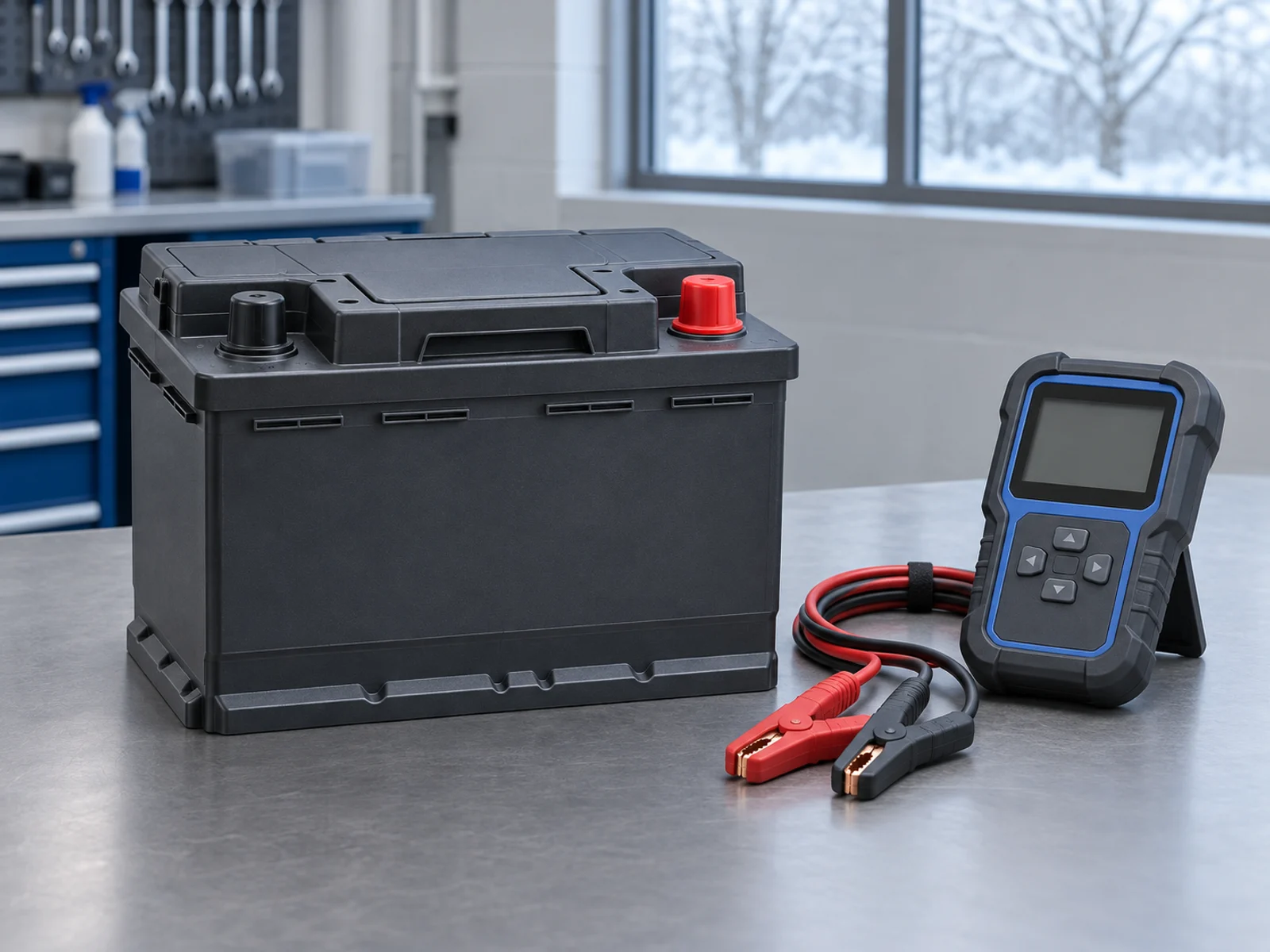
A battery label brings together several measures of finished-battery performance. Capacity, cold-start current and vehicle fitment each require their own supporting information. For material selection, return to the target battery design and validation conditions.
Read Ah together with the hour rate
Read Ah together with the hour rate
Ah means ampere-hours and expresses rated capacity under specified conditions. An entry such as Capacity (20hr) includes the hour rate as part of the specification. GS Yuasa illustrates the relationship with a 60Ah battery delivering 3A for 20 hours under its stated test basis. This example explains the rating. Actual loads, temperature, battery condition and operating endpoints still need consideration when estimating runtime. Record the hour rate and test basis alongside the Ah number when comparing products. Rated capacity alone cannot establish the current available for a cold engine start.
Read CCA together with the test standard
Read CCA together with the test standard
CCA means Cold Cranking Amperes and concerns high-current delivery under cold-start test conditions. The starter requires substantial current for a short period. CCA uses amperes, while Ah uses ampere-hours, so the two numbers describe different quantities. Capacity cannot be converted directly to CCA. GS Yuasa also notes differences in cold-cranking ratings between standards. Check the standard designation before comparing values. This article uses the purpose of the rating without prescribing temperatures, durations or cutoff voltages for individual standards. A product comparison needs an aligned test basis.
A model example shows why both ratings appear
A model example shows why both ratings appear
GS Yuasa’s YBX9096 product page is headed 12V 70Ah 760A(EN). Its specification gives nominal voltage 12V, Capacity (20hr) 70Ah, CCA 760A and separator type AGM. These figures describe that published GS Yuasa model and retain their model and test context. The capacity entry and cold-start entry answer separate performance questions about the same complete battery. Their presence on one label supports reading them together. Neither figure defines a universal AGM requirement or a separator-level result, and neither can stand in for the other during evaluation.
Confirm vehicle fitment after reading the label
Confirm vehicle fitment after reading the label
Review the required battery technology, dimensions, terminal layout, hold-down arrangement and start-stop needs against the vehicle manufacturer’s instructions. Start with Ah and its hour rate, then CCA and its standard, and finally confirm the complete fitment specification for the particular vehicle. Increasing one label value does not establish suitability. When a vehicle fails to start, state of charge, use history and the electrical system may also matter. A technician should assess the vehicle using the relevant manufacturer information. Label interpretation alone cannot determine the cause or select a replacement for every vehicle.
AGM separator data belongs within whole-battery design
AGM separator data belongs within whole-battery design
Capacity and cold-start performance result from the complete battery and its specified tests. Plates, active material, electrolyte, conductive connections, assembly and material interactions all contribute to design and validation. Within AGM batteries, the glass-fiber separator separates the plates, retains electrolyte and permits ionic transport. Hollingsworth & Vose describes this internal functional role in its supplier document. The description supports understanding the material’s place in the design. A separator property alone cannot demonstrate a particular finished-battery CCA, Ah rating or vehicle suitability.
Prepare a material discussion with validation conditions
Prepare a material discussion with validation conditions
Provide the target starting duty, battery structure, applicable test standard and whole-battery validation method together with the separator specification. Include installed thickness, plate-group compression and manufacturing conditions when available. Material tests can support sample matching under agreed conditions. The battery manufacturer confirms the final Ah, CCA and vehicle suitability within its complete design. Viking supplies AGM separators and specification support to lead-acid battery manufacturers. Share your cold-start duty, structure and validation conditions to discuss roll or sheet samples and an appropriate material specification.
FAQ 1
Can Ah be converted directly into CCA?
Ah and CCA measure different quantities under different tests. Compare rated capacity and cold-start current on their respective stated bases.
FAQ 2
Does a higher Ah rating guarantee vehicle fitment?
Confirm battery technology, dimensions, terminals, hold-down, start-stop requirements and manufacturer instructions together with Ah and CCA.
FAQ 3
Can one separator parameter establish a finished battery’s CCA?
Material data supports matching within the battery design. The battery manufacturer must verify CCA and capacity through the applicable complete-battery tests.