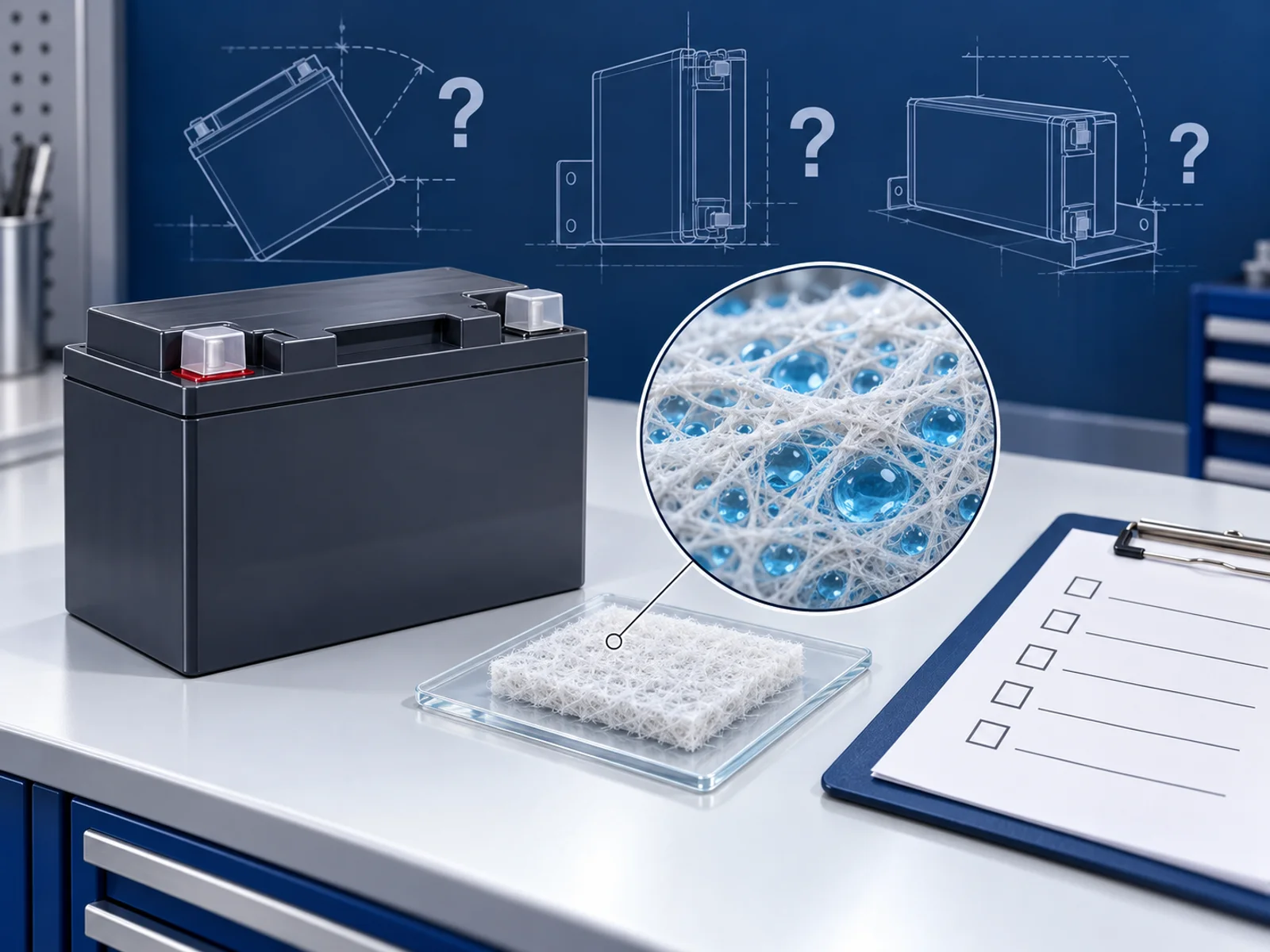
An AGM separator holds electrolyte within its glass-fiber structure, but that material property does not authorize every battery orientation. Installation limits must be confirmed for the specific battery model and its complete design.
Electrolyte retention is not installation approval
Electrolyte retention is not installation approval
AGM stands for Absorbent Glass Mat. The separator retains electrolyte within its fiber pores and keeps it between the positive and negative plates. This mechanism helps manage electrolyte inside the battery and can support greater flexibility in installation angle than a flooded design. However, the separator is only one part of the finished battery. The enclosure, lid sealing, safety-valve position, terminal layout, internal group restraint and intended operating conditions must also be considered. The absence of visible leakage in one position does not establish long-term suitability or manufacturer approval. The term “AGM” therefore cannot determine on its own whether a battery may be tilted, side-mounted or inverted. The material provides a design basis; the permitted orientation depends on the complete product design and its validation.
Tilting, side mounting and inversion are different conditions
Tilting, side mounting and inversion are different conditions
The phrase “installed on its side” is often ambiguous. It may describe placing one side of the battery downward, laying the battery on its back or fully turning it over. These positions change the orientation of the electrolyte, valves and terminals in different ways and should not be treated as equivalent. In its FAQ section “Can an AGM battery be installed in any position?”, Yuasa states that most applications still use an upright installation. It also notes that some applications may require a tilted position or placement flat on the battery’s back, and that retained electrolyte gives AGM batteries more installation-angle flexibility than batteries with free-flowing electrolyte. The FAQ does not provide a universal angle table or authorize inverted use for every AGM model. The page showed no explicit publication date and was checked on October 31, 2026. It is Yuasa product guidance, not a Viking Technology test or an installation approval covering every brand and model. A model approved for one side-mounted position does not establish that another model supports the same position, and side mounting does not imply that inversion is acceptable. The manual, product label and manufacturer guidance for the exact model remain decisive.
Confirm the complete battery requirements before installation
Confirm the complete battery requirements before installation
For any non-upright installation, first define the proposed geometry precisely: whether the battery will be tilted, placed on a side, laid on its back or fully inverted; which face will point downward; and where the terminals and valve openings will face. Equipment designers, vehicle manufacturers, service teams and distributors should then confirm whether the exact battery model is approved for that position. Available space is not proof of compatibility. If the original equipment layout, equipment-manufacturer requirements and battery-manufacturer instructions appear to conflict, the relevant equipment or battery technical personnel should resolve the issue before installation. A short trial that shows no seepage cannot replace formal confirmation because it does not cover long-term operating conditions, sealing performance or reliability requirements. An unusual orientation alone also does not prove that a battery is leaking or safe. If the enclosure, valve area or equipment compartment appears abnormal, follow the battery and equipment manufacturers’ service procedures. This article does not provide instructions for inversion tests or owner-performed modifications.
Replacement requires more than matching dimensions
Replacement requires more than matching dimensions
Replacement decisions should not rely only on matching external dimensions. Changing the model or installation position can alter terminal and cable routing, enclosure support, compartment clearance and maintenance access. Even when both batteries use AGM construction, approval must be based on the replacement model in the target equipment.
The separator supports battery design but cannot certify the finished battery
The separator supports battery design but cannot certify the finished battery
For battery engineering teams, the target orientation should be defined during finished-battery design and validated by the battery manufacturer against the product requirements. The object of validation is the complete battery under its intended conditions, not an isolated separator placed in a different direction. Where a product is expected to experience particular vibration, temperature or long-term operating conditions, the manufacturer should incorporate those conditions into the applicable validation plan. This article does not propose universal test durations, angles or acceptance thresholds. Packaging labels, product instructions and after-sales materials should remain consistent with the resulting design and validation limits. AGM separator retention is one material property considered in battery design. For a defined product, the battery manufacturer may evaluate it together with the plate-group structure, separator specification, electrolyte configuration and enclosure design. Material evaluation can determine whether a separator meets specified design and process requirements, but it cannot independently authorize an installation orientation for the complete battery. Viking Technology supplies AGM separators and supports specification discussions with battery manufacturers. Separator matching should be verified against the target battery structure by the material and battery-manufacturing teams. Permission to tilt, side-mount or invert the completed battery remains the responsibility of that model’s manufacturer.
FAQ 1
Can every AGM battery be installed upside down?
No. The AGM designation and electrolyte retention do not authorize inversion. Follow the manual, label and manufacturer approval for the exact model and target equipment.
FAQ 2
Does approval for side mounting also cover inversion?
No. Tilt, placement on a side, placement on the back and full inversion are different geometries. Confirm the downward face and the directions of terminals and valve openings.
FAQ 3
Does a leak-free trial prove the position is safe?
No. A short observation without seepage cannot replace finished-battery design validation or model-specific installation approval.